
Hoover Dam and the Boulder Transmission System have served Los Angeles with an incredible track record of prosperity and reliability over the last 90 years, establishing the City of Los Angeles as the one of industrial and defense manufacturing capitals of the world. The inexpensive hydropower from Hoover Dam, coupled with significant new customer load, enabled power to become so inexpensive and abundant that LADWP did not have to raise electricity rates for 36 years.
During these 36 years, LADWP was able to provide 12 successive rate reductions directly to customers. In the first 10 years of Hoover Dam’s operation, the population of the City of Los Angeles increased from 1,372,000 in 1936 to 1,805,000 in 1946. The overall number of LADWP electric customers more than doubled, and the number of industrial customers more than tripled. During this first decade, the average Los Angeles home doubled its use of electricity.
Hoover Dam and the Boulder Transmission System also allowed the City of Los Angeles to recover from what is considered the most severe problem ever faced by LADWP: the first ever citywide blackout and blackstart event resulting from the January 17, 1994 Northridge Earthquake. LADWP was able to dispatch Hoover Dam Power through the 287.5 kV Boulder Lines I and II, allowing for initial power restoration to the Watts community in just 38 minutes via Receiving Station B at 98th Street and Central Avenue. Power was restored to 93 percent of LADWP’s electric customers within 24 hours following this devastating magnitude 6.7 earthquake.
As LADWP prepares to initiate a $1.5 billion upgrade in 2026 on two 162-mile segments of this system between Boulder City and Victorville, these transmission lines will be enhanced to continue to reliably deliver clean energy to Los Angeles in support of L.A.’s 100 percent carbon free energy goals.
LADWP Boulder Transmission System History
Completed in 1936 and spanning 266-miles from Hoover Dam to Receiving Station “B” at 98th Street and Central Avenue in South Los Angeles, the LADWP Boulder Transmission System took three years to construct. Like the water from the Eastern Sierra delivered via the Los Angeles Aqueduct, Hoover Dam and the Boulder Transmission System were similarly instrumental in the growth and prosperity of Los Angeles with respect to energy.
Working out of seven camps and four field headquarters sites, 1,608 LADWP employees constructed access roads, erected towers, and strung cables in heat that sometimes reached 135 degrees Fahrenheit.
A third transmission line spanning 258-miles known as Boulder Line III was fully completed in 1940 to address rapid load growth from new industry, electrification growth, and additional customers following LADWP’s acquisition of the Los Angeles Gas & Electric Company in 1937. This third line terminates at Receiving Station “E” in North Hollywood.
Receiving Station “B” and “E” are also known as the Century and Toluca Receiving Stations, respectively. For decades, the original lines that comprise this system were known as Boulder Lines I, II, and III, but today they are referred to by their individual line segments, which are the start and end points between high voltage stations.
Beginning with the initial delivery of cheap and abundant hydroelectric power, to carrying a significant amount of renewable energy today, the Boulder Transmission System celebrates its 90th Anniversary in 2026 as a versatile and vital transmission pathway to Los Angeles.
While two of the original Boulder Transmission Lines have since been reconfigured and upgraded to 500 kV using contemporary steel reinforced braided aluminum cable, most of the original lattice steel 1930s era single and double circuit transmission towers remain standing today. While they continue to carry power from Hoover Dam, they also now transmit power to Los Angeles from many other generation resources in the Western United States. Several 287.5 kV segments of the Boulder Transmission Line remain in operation and are regularly operated at more than 300 kV to maximize the amount of power delivered to Los Angeles.
On these 287.5 kV segments, most of the original hollow copper transmission cable and tower insulator assemblies remain in use today. This 1930s era City-owned infrastructure serves as a standing monument and testament to the ingenuity, design, engineering, and uncompromising construction standards of LADWP’s first Chief Electrical Engineer Erza F. Scattergood and those who worked for him.
L.A. Visionaries Behind the Hoover Dam
Ezra F. Scattergood
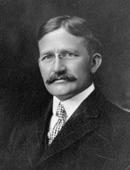
A preeminent proponent of public power and municipally owned utilities, Ezra F. Scattergood, founded the City of Los Angeles municipal electric system and served as its first Chief Electrical Engineer. Known as the ‘‘father of municipal power,” Scattergood was hired by the City of Los Angeles in 1906 as Consulting Electrical Engineer to supervise the installation of the equipment needed to furnish power for construction work of the Los Angeles Aqueduct. In 1908, Scattergood was appointed Chief Electrical Engineer of the newly formed Bureau of Aqueduct Power, which became the Bureau of Power and Light in 1911 after citizens voted in favor of distributing power as a municipal enterprise by a 10 to 1 margin.
In 1916, the municipal distribution of electric power commenced on the east side of Los Angeles. In 1920, Scattergood looked to the Colorado River to meet the City’s growing demand for electricity. Working with father of the Los Angeles Aqueduct William Mulholland, Scattergood spent most of the 1920s fighting for Hoover Dam’s development. He was one of the key parties responsible for Congress passing the 1928 Boulder Canyon Project Act that authorized the Dam’s construction. Scattergood also guaranteed the largest share of power purchase contracts needed to repay the federal government the $108 million Dam construction cost within 50 years.
In 1933, Scattergood obtained a $22.8 million loan from the federal Reconstruction Finance Corporation to build the Boulder Transmission System to Los Angeles. Scattergood also aided the federal Bureau of Reclamation engineers in the design of the Hoover Power Plant generating units. Hoover Dam and the Boulder Transmission System helped the United States recover from the Great Depression and ultimately win World War II. The low-cost hydro power served as the impetus for a 1930s LADWP building electrification campaign, which stimulated massive load growth and attracted large commercial and industrial customers to Los Angeles. Culminating a more than two-decade long battle between proponents of municipally owned power and private utility interests, Hoover Dam enabled LADWP to become the sole provider of electricity within the City of Los Angeles and initially supplied as much as 97% of the City’s power. Scattergood retired in 1940 but remained at LADWP as Advisory Engineer until his passing in 1947.
William Mulholland
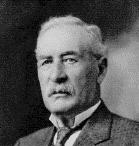
William Mulholland, the first Chief Engineer of LADWP’s Bureau of Water Works and Supply, is the visionary behind the construction of the Los Angeles Aqueduct, which began delivering water from the Eastern Sierra to Los Angeles in 1913. When the City once again faced a water shortage following years of rapid growth, Mulholland initiated surveys and engineering investigations in October 1923 to assess the feasibility of constructing a new aqueduct. Beginning at Boulder Canyon, he led the original Colorado River Aqueduct surveys that ultimately covered 50,000 square miles.
In 1930, LADWP transferred its responsibilities for the Colorado River Aqueduct Project to the Metropolitan Water District of Southern California, which had been formed in late 1928 by the City of Los Angeles and 12 other Southern California cities. The 242-mile Colorado River Aqueduct was completed in 1941.
Hoover Dam Power Arrives in Los Angeles
At precisely 7:36 p.m. on October 9, 1936, Elizabeth Scattergood, the daughter of LADWP Bureau of Power and Light Chief Electrical Engineer and General Manager Ezra F. Scattergood, pressed a key that brought the first power from Hoover Dam surging over the 266 miles of the world’s highest voltage transmission line to a waiting Los Angeles. Instantly, a flaming arc sputtered and crackled atop poles near the corner of Temple and North Spring Streets and bathed the Civic Center in an eerie brilliance for a few moments. As the flame died down, 16 huge searchlights on the City Hall tower lit up the sky while smaller sun arcs set Broadway ablaze in a scene more impressive than any Hollywood premiere. This was the signal for the start of “Light on Parade,” a two-and-a-half-mile pageant of colorful electric floats, drill teams and marching bands that thrilled the estimated one million people who jammed the streets of downtown that night. There was general agreement that the arrival of power from Hoover Dam marked the beginning of a “New Electrical Age,” but few realized the years of planning, innovative research and dedicated work by LADWP that went into bringing it about.
Prior to receiving power from Hoover Dam, Southern California Edison contractually provided approximately 60.5 percent of LADWP’s energy generation. Hoover Dam would now provide enough power to make the City of Los Angeles municipal electric system self-sufficient. In 1937, local voters approved LADWP’s acquisition of the private Los Angeles Gas & Electric Company, and in 1939, all remaining portions of the Southern California Edison system within the municipal boundaries of the City were purchased. These acquisitions enabled LADWP to become the sole provider of electricity within the City.