

The benefits of increasing our renewable power supply include reducing greenhouse gas emissions, helping to eliminate the need for traditional fossil fuel power resources, improving air quality, providing a sustainable energy resource, and reducing dependence on foreign sources of fuel.
Progress
LADWP and City of Los Angeles leaders have been at the forefront of California utilities in adopting aggressive clean energy and greenhouse gas (GHG) reduction goals. LADWP has achieved all state-mandated Renewable Portfolio Standard (RPS) targets to date including, most recently, achieving 33 percent RPS by 2020. In 2016, LADWP achieved the target set by California Senate Bill 32 to reduce GHG emissions to 40 percent below the 1990 baseline level by 2030. LADWP met and exceeded this target 14 years ahead of the deadline. By the end of 2022, LADWP’s power mix was 52 percent carbon-free and our GHG emissions level was estimated to be 7 million metric tons (MMT)—approximately 60 percent below our 1990 emissions baseline of 17.9 MMT
For calendar year 2024, LADWP’s power mix was comprised of 59 percent carbon-free resources, including 41 percent renewables.
Policy and Legislation
In September 2018, the Governor signed into law the Senate Bill 100, which accelerated the state RPS to 60 percent by 2030. The bill also requires that 100 percent of all retail sales of electricity come from eligible renewable energy and zero-carbon resources by 2045.
Under the direction of the Mayor and City Council, the City of Los Angeles has set accelerated goals to supply 100 percent clean energy for Los Angeles by 2035 and 80 percent renewable energy by 2030. These goals were based on the findings of the LA100 Study, completed in 2021, which offered several scenarios for achieving 100 percent clean energy by 2045 to meet the state requirement under SB 100, and by 2035 in the most accelerated scenario.
RPS Strategy
As LADWP expands its renewable resource portfolio, it is important that it does so in a cost-effective manner to minimize the impact on ratepayers. Some of the key considerations in selecting these resources include:
- Costs and operational impact of integrating renewables
- Technologies that deliver more energy during peak hours
- Preference for local projects
- Locating projects near existing transmission and other LADWP assets such as land and power infrastructure
- Diversification of resources
DER Strategy
As we increase renewable energy resources to meet local and state goals, we are also expanding our distributed energy resource (DER) portfolio, which includes small-scale energy generation, such as rooftop solar, along with energy storage, energy efficiency, and demand response programs. We are working to grow the DER portfolio in a cost-effective manner to minimize the impact on customers and through collaboration with the private sector. This strategy includes engaging with property owners and maximizing capacity in preferred DER zones.
To that end, in 2025, the Los Angeles Board of Water and Power Commissioners approved an investment of $195 million to expand LADWP’s Demand Response portfolio to deliver 340 MW of grid load flexibility.
Related Programs
-

Building Benchmarking
This webpage will guide you in obtaining and tracking your energy and water consumption, using the ENERGY STAR Portfolio Manager®. This will help you comply with the City of Los Angeles’ Existing Building Energy and Water Efficiency Ordinance (EBEWE), which became effective January 1, 2017. It also serves to comply with State Legislation that requires statewide building energy use benchmarking.
-

Business Offerings for Sustainable Solutions (BOSS)
Let our Business Offerings for Sustainable Solution (BOSS) program’s rebates help with the cost of your next efficiency project!
-

CES2G
CES2G, also known as the Commercial Energy Storage to Grid pilot program, is the nation’s first municipal utility vehicle-to-grid (V2G) and energy storage-to-grid program.
-

Commercial Direct Install Program
The Commercial Direct Install (CDI) Program is available to qualifying businesses whose average monthly electrical demand is 250 kilowatts (kW) or less. If you are interested in making your operation more energy efficient, we can help.
-
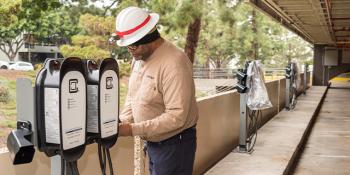
Commercial EV Charger Rebate Program
Rebates, for light, to heavy-duty vehicles, help support the growth of Los Angeles’ robust charging network.
-
Commercial Lighting Incentive Program
The Commercial Lighting Incentive Program provides rebates on the installation of newly purchased and installed energy-efficient lighting and controls.
-

Comprehensive Affordable Multifamily Retrofits Program
The Los Angeles Department of Water and Power’s Comprehensive Affordable Multifamily Retrofits (CAMR) program assists L.A.’s low income, multifamily property owners.
-
Demand Response Program
LADWP’s Demand Response (DR) is an incentive based, voluntary energy management program for businesses that helps reduce their utility bills during times of peak power demand, ensuring the continued reliability of power for Los Angeles.